
Course overview
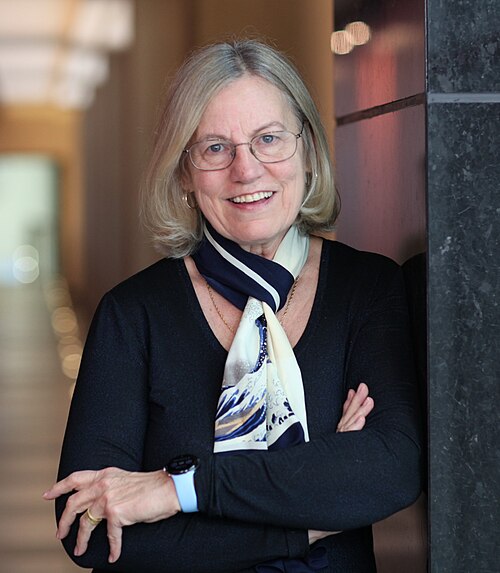
This is the public webpage for the Digital Communications course taught by Prof. Leslie Rusch at Université Laval (course codes: GEL-7014, GEL-4200, and GEL-7114).
The site is organized by modules. For each module, you will typically find slides, recommended reading, exercises derived from posted exams, and supporting videos.
Objectives
This course supports the following program-level objectives:
- Understand technologies relevant to multiple application areas in electrical engineering
- Apply acquired knowledge to the design and implementation of engineering systems
- Build foundations applicable to hardware, software, control, CAD/CAM, instrumentation, intelligent systems, multimedia, and digital communications
Course content
- Digital vs. analog communications; system block diagrams
- Noise models and probabilistic analysis
- Optimal receivers and signal space concepts
- Nyquist signaling and ISI mitigation
- Digital modulation formats and performance analysis
- Noncoherent detection techniques
- Spectral efficiency and Shannon capacity
- Channel equalization and multicarrier systems
- Forward error correction and trellis-coded modulation
Introduction
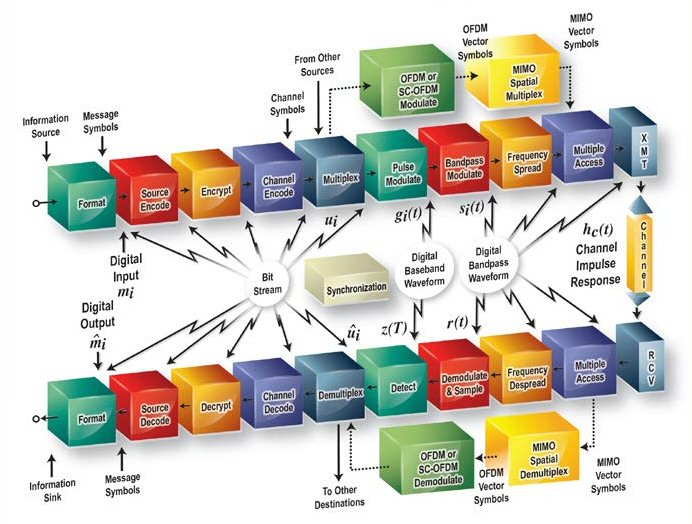
This course introduces the foundations of digital communications, from probabilistic noise models and optimal receiver design to modulation, coding, and equalization techniques used in modern communication systems.
- Random signals and random processes; mathematical models of noise (AWGN)
- Receiver design criteria: MAP, ML, and maximum-SNR
- Signal-space representation; matched filter and correlator receivers
- Nyquist pulses, intersymbol interference (ISI), and eye diagrams
- Modulation formats: MFSK, MPSK, and QAM; coherent and noncoherent detection
- Spectral efficiency and channel capacity (Shannon limits)
- Error-control coding and trellis-coded modulation
- Channel equalization: zero-forcing and MMSE
Learning outcomes
By the end of this course, you should be able to:
- Apply analysis and synthesis methods in communication-system design
- Select appropriate modulation formats for a given communication link
- Select suitable digital signal processing techniques
- Evaluate and compare communication-system performance
Contact
Leslie Rusch
Email: rusch@gel.ulaval.ca
Website: https://leslie-rusch.fsg.ulaval.ca
Location: Québec City, QC G1V 0A6